

When something traumatic happens in a healthcare setting, the organization usually has a clinical and operational response. Patients still need care, families need communication, documentation has to happen, and the shift has to keep moving. But the human response for the team is often less clear.
That gap was the focus of Marvin Behavioral Health’s recent Becker’s Healthcare webinar, The First 24 Hours: How Novant Health and Others Are Redesigning Post-Incident Support for Healthcare Workers.
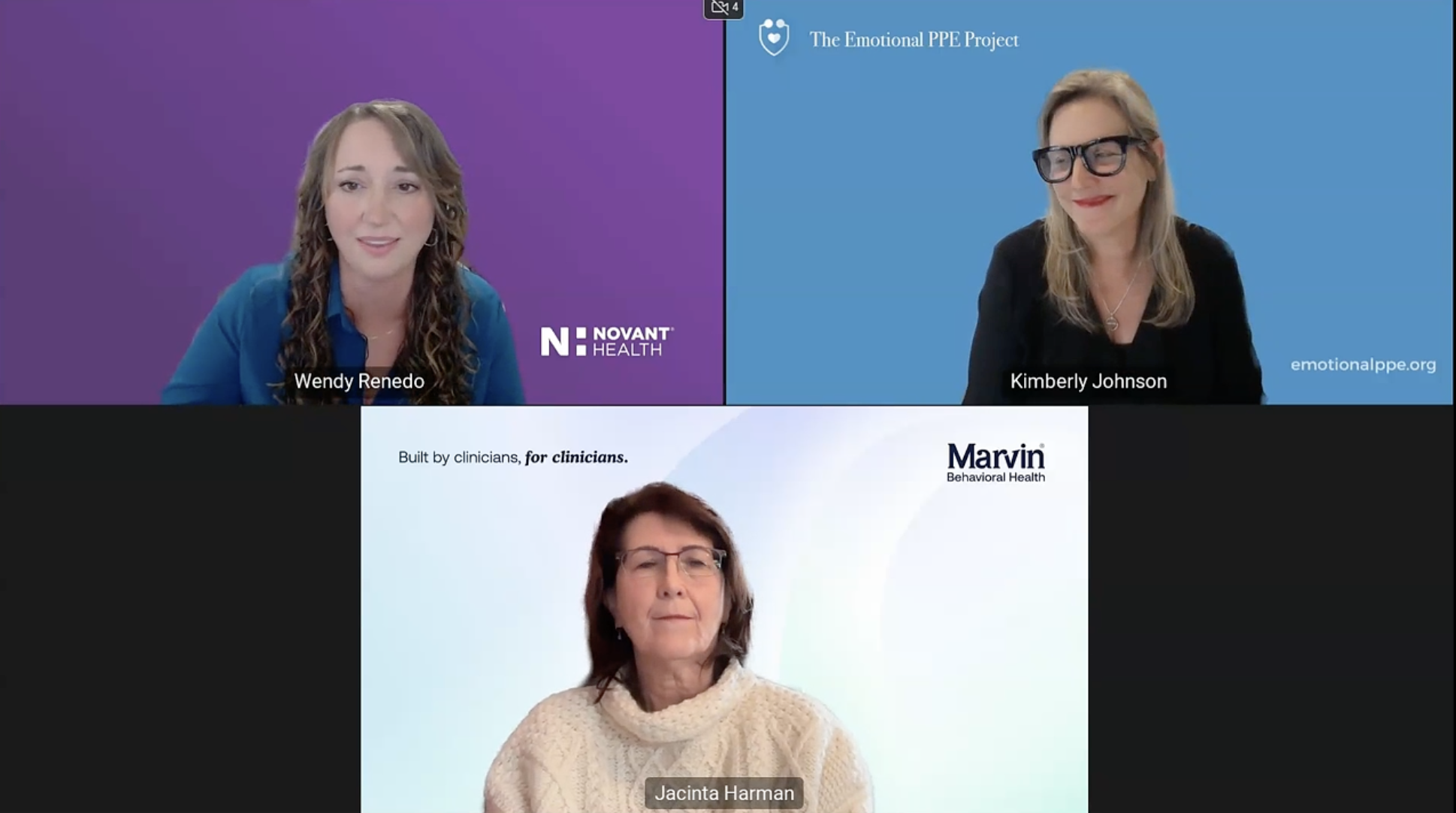
The conversation brought together Wendy Renado, nurse leader and manager of well-being and resiliency at Novant Health; Dr. Kimberly Johnson, licensed mental health counselor, counselor educator, clinical supervisor, and board member of the Emotional PPE Project; and Jacinta Harmon, vice president of clinical services at Marvin Behavioral Health.
Together, they explored what healthcare workers and leaders need after traumatic events, why traditional post-incident responses often fall short, and how health systems can build support that is structured, timely, confidential, and grounded in the realities of healthcare work.
Watch the entire event on-demand now
Trauma doesn't always show up right away
One of the clearest themes from the discussion was that healthcare workers don't always have an immediate emotional or psychological response after a traumatic event.
Dr. Johnson described how often the impact appears later, after the urgency has passed and the brain has a chance to quiet down. For some healthcare workers, the response is cumulative. It may come after three or four difficult events, or it may be a smaller incident that finally brings the weight of previous experiences to the surface.
That matters because many post-incident responses are built around a narrow window. A difficult event happens, resources are shared, perhaps a debrief is offered, and then the organization moves on. But the people involved may still be processing what happened days, weeks, or months later.
In healthcare, this is especially important because the work rarely pauses long enough for people to understand what they 'e carrying. A clinician may leave one difficult room and walk directly into the next. A manager may support a shaken team while also managing staffing, patient flow, family communication, and executive updates. A nurse may appear composed during the shift and then feel the full impact in the car, at home, or the next time something familiar happens.
Post-incident support has to account for that complexity. It can't assume that one event creates one uniform reaction, or that silence means someone is fine.
“They signed up for this” is not a support strategy
Wendy Renado from Novant Health named a belief that still shows up in healthcare culture: the idea that because someone chose this work, they should be expected to handle whatever comes with it.
That assumption can be quietly damaging. Healthcare workers may understand that loss, uncertainty, violence, suffering, and high-stakes decisions are part of the profession. That does not mean those experiences leave them untouched.
A nurse who works in hospice may expect to encounter death. An ICU clinician may understand that not every patient will recover. An emergency department team may know that violence and volatility are possible. But professional exposure does not erase human response. Experience may help someone function in the moment, but it does not make them immune to grief, fear, moral distress, cumulative stress, or exhaustion.
The distinction matters. When organizations treat trauma as something healthcare workers should simply absorb, they shift the burden onto the individual. When they acknowledge that healthcare work can affect people deeply, they create room for a more humane and more operationally sound response.
Support after traumatic events should not be treated as a courtesy. It should be part of the infrastructure of healthcare work.
Leaders do not need perfect words. They need a way to show up.
A major thread in the conversation was the pressure leaders feel after a traumatic event. Many leaders care deeply about their teams, but they may not know what to say or do. That uncertainty can lead them to retreat into safer, more procedural responses, such as sending a resource list, forwarding an EAP link, or telling staff to reach out if they need anything.
Those gestures may be well-intentioned, but they often miss what people need most in the moment.
Wendy emphasized that presence matters. Team members often need leaders to show up, acknowledge what happened, stay connected, and continue checking in. They do not need the perfect script. They need to know that the person responsible for the team has not disappeared because the situation is uncomfortable.
Dr. Johnson added that some responses can become performative. The email, the pizza party, the generic reminder to practice self-care, or the open-ended “let me know what you need” can unintentionally place responsibility back on the person who is already overwhelmed. After a traumatic event, many people do not know what they need yet. Some may be numb. Some may be overloaded. Some may be trying to get through the next hour.
This is where leader training matters. Leaders need practical guidance on how to listen, how to validate, how to avoid minimizing language, how to recognize when someone may need additional support, and how to remain present without trying to become a mental health care provider.
The manager is affected too
Post-incident support often focuses on the team directly involved in the event. That focus is necessary, but it's incomplete.
Managers are often carrying the team while also carrying their own response. They may be checking on staff, coordinating coverage, responding to senior leaders, communicating with families, and trying to keep the unit steady. At the same time, they may be grieving, shaken, angry, afraid, or unsure whether they handled the moment well.
The webinar surfaced an important point: the person holding everyone else together also needs support.
As Wendy noted, healthcare often promotes excellent clinicians into leadership without giving them the skills to lead people through emotionally complex moments. A strong bedside nurse may become a charge nurse or manager because of clinical skill, seniority, and trust. That does not mean they have been trained to support a team after a workplace violence incident, unexpected patient death, medical error, staff suicide, or other traumatic event.
Leaders need more than a list of resources. They need a framework for what support looks like in practice. They need help understanding what questions to ask, what language to avoid, and when to bring in additional care. They also need permission to recognize their own response instead of assuming they have to be untouched by the event because they are in charge.
Psychological first aid can help without turning peers into clinicians
Dr. Johnson described psychological first aid as a practical, non-clinical approach that can help people regain enough stability and connection to keep going. It does not require someone to tell their full story. It does not force emotional processing before a person is ready. It focuses on what the person needs in the moment and how to help them regain a sense of equilibrium.
That distinction is important for healthcare settings. Leaders and peers should not be expected to provide clinical mental health support unless they are trained and licensed to do so. Their role is different. They can notice distress, listen without rushing to fix it, validate the experience, help someone access resources, and stay connected over time.
Wendy described a similar approach through Stress First Aid and peer support at Novant Health. In a large organization with more than 40,000 team members, peer support is essential because support has to exist close to where the work happens. People already support each other informally. The opportunity is to give them better tools, clearer language, and a stronger connection to formal resources when someone needs more help.
Peer support is not a substitute for licensed mental health care. It is a bridge. Used well, it can help people feel less alone, reduce stigma, and make it easier to access additional support before distress becomes more severe.
Novant’s turning point: “Are we allowed to cry at work?”
One of the most powerful moments in the webinar came when Wendy shared a story from her time back at the bedside during COVID.
After losing a young patient who had been on the unit for some time, she walked out of the room and started to cry. A younger nurse saw her and asked, “Are we allowed to do that?”
The question stayed with her. It revealed the quiet rule many healthcare workers internalize: hold it together, keep moving, process it somewhere else, or do not process it at all.
For Wendy, the moment helped crystallize the need for something more structured. Novant Health was already partnering with Marvin to provide one-on-one mental health support for team members. From there, the teams began exploring what it could look like to bring back a more intentional post-incident support process, including virtual options and facilitated conversations.
What emerged was not a one-size-fits-all model. Some teams needed a facilitated conversation after an event. Some leaders needed guidance before speaking with their staff. Some teams needed multiple sessions over time, particularly after events that left people fearful about whether something similar could happen again.
That flexibility became one of the strengths of the approach. The response could be shaped around the team, the leader, the event, and the needs that surfaced over time.
Confidentiality is central
The webinar also addressed a barrier that can't be ignored: many healthcare workers worry about confidentiality when seeking mental health support.
Dr. Johnson and Wendy both described how common it is for clinicians to worry that talking to someone could affect their license, their reputation, or how they are perceived at work. Some may not want support through an internal program. Others may not want to use insurance because they do not want a record connected to their care.
Those fears are not abstract. Healthcare workers have spent years receiving messages, formally and informally, that mental health support can carry professional risk. Licensure questions, workplace stigma, and the culture of perfection have all contributed to hesitation.
That is one reason external support can feel safer. Wendy noted that Novant team members appreciate having a resource outside the organization. Marvin’s model provides access to licensed mental health providers outside the health system’s EHR, which helps create the separation and trust many healthcare workers need before they are willing to engage.
Confidentiality is not a secondary feature of post-incident support. For many healthcare workers, it is the condition that makes support usable.
Access matters as much as availability
Another important takeaway was that support is not defined only by whether resources technically exist. It's defined by whether people can access the right support at the moment they need it.
A long list of resources may be useful later, but immediately after a traumatic event, people may be overloaded, numb, dissociated, or simply unable to absorb information. Wendy described how often someone may receive a resource in the moment and then call the next day because they know something was shared but cannot remember the details.
This is why follow-up matters. It is also why access has to be simple. If support requires too many steps, too many clicks, or too much explanation, people may never get there.
For post-incident care, ease of access is not a convenience issue. It is a clinical and operational design issue. Support needs to be visible, easy to activate, and available when the person is actually ready to use it.
The same is true for crisis support. Jacinta described the importance of having a 24/7 crisis line available for healthcare workers who may need to speak with someone after they leave work, when the adrenaline has worn off and the event is still sitting heavily in the body. In that moment, the goal may not be formal ongoing care. It may simply be having a licensed person available to listen, validate, normalize, and help the worker get through the next stretch of time.
Culture change requires more than resilience language
The panelists also discussed resistance from leaders who built their careers in environments where this kind of support did not exist. Many healthcare workers were trained to leave everything at the door, focus on the patient, and keep going.
Wendy challenged that idea directly. People do not stop being parents, caregivers, spouses, children, or human beings when they enter the hospital. They may be caring for a special-needs child, worrying about an aging parent, grieving a loss, or carrying stress from home into work. Pretending otherwise does not make the work safer. It makes the burden less visible.
Dr. Johnson made a similar point. “I turned out fine” is not a measurement strategy. In many cases, people did not turn out fine. They endured, adapted, compartmentalized, or paid the price somewhere else.
That price often shows up outside of work first. As Wendy noted, healthcare workers may appear composed during the shift while functioning on a very low battery at home. Their families may see the exhaustion, withdrawal, irritability, or absence that colleagues and leaders do not.
A healthier culture does not ask people to pretend they are unaffected. It creates systems that allow them to stay connected to the work without losing themselves to it.
What health systems can take from the conversation
The webinar offered several practical lessons for healthcare leaders building or improving post-incident support.
First, delayed reactions are common. Leaders should not assume that someone is fine because they appear composed immediately after an event.
Second, support should be layered. Immediate stabilization, peer support, leader check-ins, facilitated team conversations, crisis access, and one-on-one mental health support each play a different role.
Third, managers need guidance and support, not just responsibility. They're often asked to hold the team together without having been trained for the emotional complexity of that role.
Fourth, confidentiality has to be explicit. Healthcare workers need to understand what is private, what is external, and how support is separated from workplace evaluation or licensure risk.
Fifth, access has to be simple. Support that exists but is difficult to reach will not be used when people are overloaded.
Finally, post-incident support should not depend on whether an individual leader happens to know what to do. A consistent response requires training, structure, and a reliable pathway to additional care.
Building a better response after crisis
Healthcare workers spend their careers caring for people through some of the hardest moments of their lives. When traumatic events happen to them or around them, they deserve more than a resource list and an expectation that they will keep going as if nothing happened.
They deserve support that recognizes the complexity of their work, the reality of cumulative stress, the burden on leaders, and the importance of confidential care.
Take the next step
Marvin’s Caring After Crisis program helps health systems respond after traumatic events with timely, structured, confidential mental health support for healthcare teams and leaders. The program includes licensed support, facilitated conversations, leader guidance, 24/7 crisis access, and follow-up care designed around the realities of healthcare work.
Because after a crisis, the first question should not be whether people are strong enough to carry it. It should be whether the system is prepared to support them.
Learn more about Caring After Crisis program


